

How to Store a Mattress in a Storage Unit
Yes, you can store a mattress in a storage unit. It comes back in good shape if it goes in clean and dry, stays bagged, lies flat on a raised surface, and stays clear on top. A mattress left standing on its side for months can sag out of shape. A mattress that goes in damp can grow mildew deep in the layers where you cannot see it. This is the method we walk customers through in Calera when a mattress is part of a move or a renovation.
Should a mattress be stored flat or on its side?
Flat
Flat is the safe position for anything longer than a few weeks. The weight spreads evenly across the whole surface, so springs and foam hold their shape.
On its side for a short time
Standing a mattress on its side works for a short stretch, a week or two during a move, and it frees up floor space. Past that, the fill settles downward under its own weight, and the mattress can keep a permanent lean. If you must stand it up, keep it brief and get it flat again as soon as you can. Treat a week or two as a conservative practical limit, not a rule that every maker states for every mattress.
Never folded
Never fold a mattress to make it fit. Folding creases foam and can snap innerspring coils. If it does not fit flat in the space you have, you need a bigger space.
Do not roll or vacuum-seal a mattress at home for storage. Factory compression is different from home rolling, and a home-rolled mattress can keep dents and creases.
If you must stack mattresses, lay each one flat in its own bag, put the heaviest at the bottom, and keep the stack as short as possible. Side by side is safer than a stack.
Get it clean and dry before it goes in
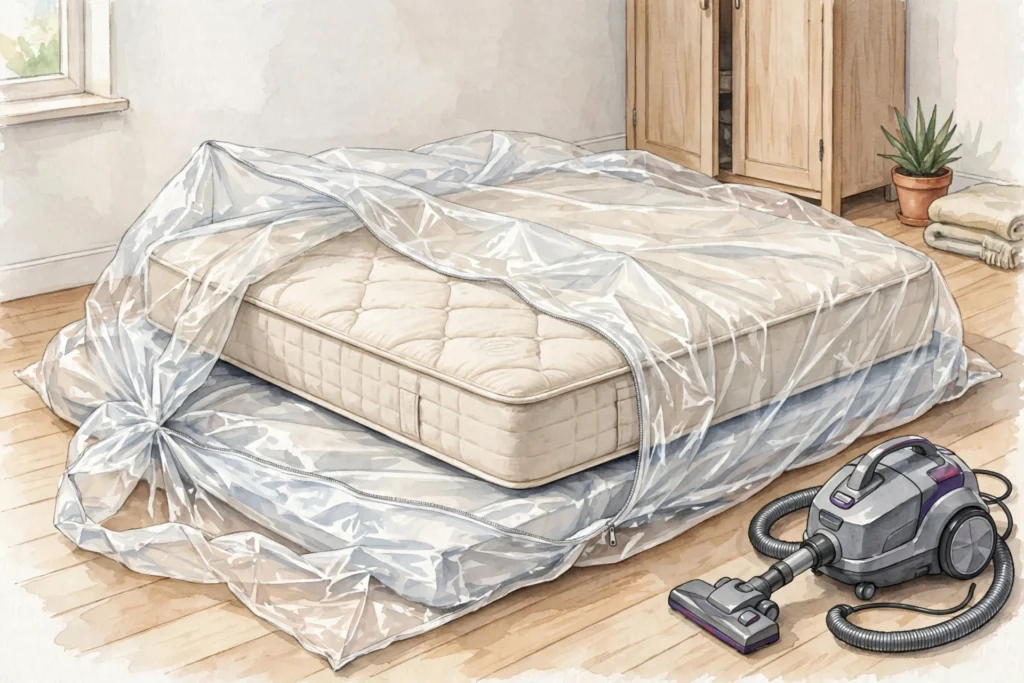
Strip the bedding and any detachable toppers. Vacuum both sides, the seams, the edges, and the crevices, using an upholstery attachment. Spot-clean by blotting, not by soaking, and follow the care label for your mattress. For odors, sprinkle baking soda over the surface, leave it for at least half an hour, then vacuum it fully.
Let the mattress dry fully after any spot cleaning. Let it air in a ventilated room, and turn it so both sides dry. If a spot still feels damp, it is not ready. Do not bag a mattress that is still damp, because moisture trapped inside a bag can encourage mildew.
Bag it before the move. Use a mattress storage bag made for the job, sized to the mattress. For a long stay, a breathable woven bag is better than thick sealed plastic, because thick plastic can trap moisture if the mattress is not fully dry. Plastic sheeting works only for a short move, not for a long stay. Slide the mattress in with a second person, tape the open end shut on the bag, never tape directly to the fabric, and check the bag for tears before you move it. A bagged mattress is also much easier to slide across a unit floor without tearing the fabric.
What size space does a mattress need?
| Mattress | Size | Flat floor space |
|---|---|---|
| Twin | 38 by 75 inches | about 20 square feet |
| Full | 54 by 75 inches | about 28 square feet |
| Queen | 60 by 80 inches | about 33 square feet |
| King | 76 by 80 inches | about 42 square feet |
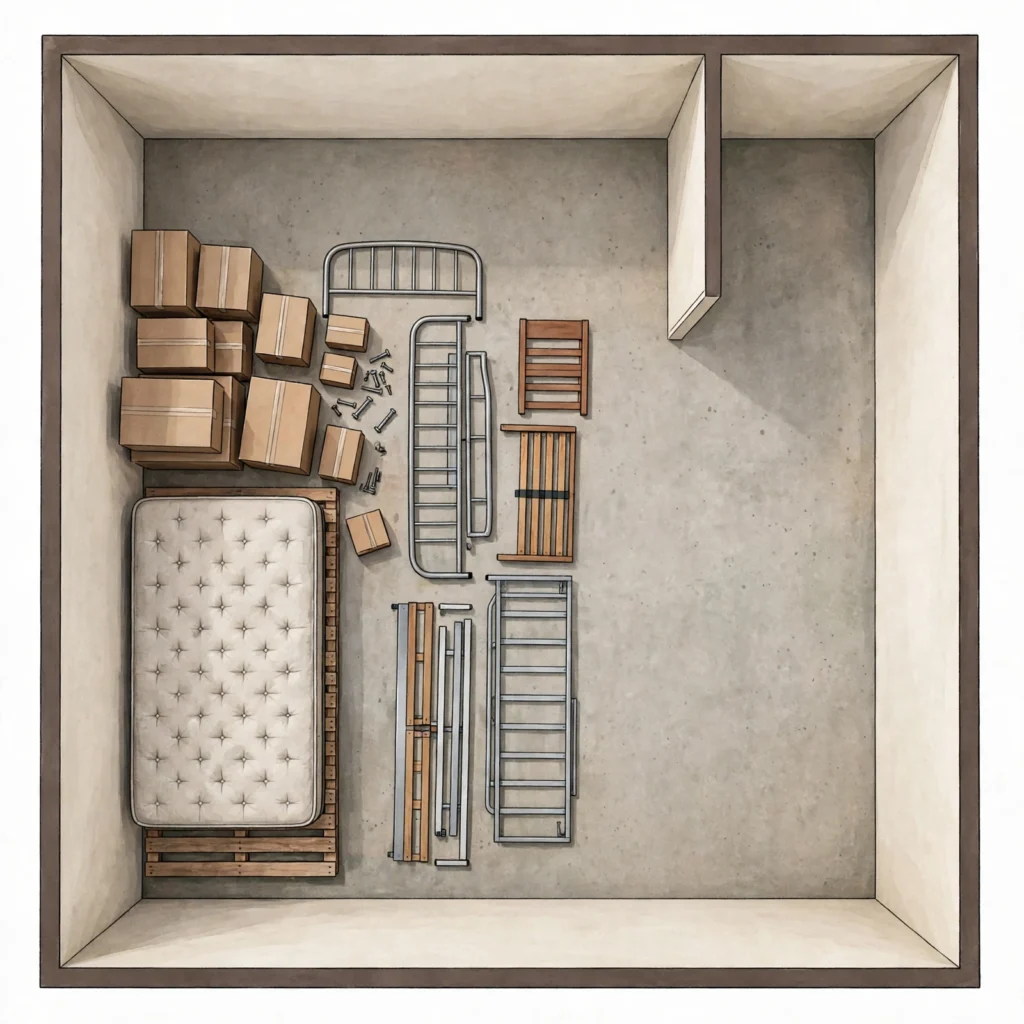
A queen laid flat takes roughly five feet by six feet eight inches of floor. In a 10×10 unit it fits along one wall. That leaves floor space for boxes and a disassembled frame, but how much remains depends on the box spring and other furniture in the same load. Our 10×10 cost page lays out what that unit holds and what it costs per month, so you can size the whole load instead of guessing.
How each mattress type changes the rule
| Mattress type | How to store it | Watch for |
|---|---|---|
| Innerspring | Flat | Coils shift if left vertical for weeks. Bending and folding damage coils. |
| Memory foam | Flat | Warps and dents if upright long term. Heat affects foam. Cold makes it stiff until it warms. |
| Latex | Flat | Heavy, so plan a two-person move. Heat affects latex. Short side only. |
| Hybrid | Flat | Foam and coil risks both apply. No long side storage. |
| Pillow-top | Flat | Top layer compresses unevenly if leaned. |
| Mattress in a box | Flat, unrolled | Unroll within the manufacturer window, then store it as a normal mattress. |
Moving it to the unit
Move the mattress in a covered truck or van, never on a car roof. Measure the doorways, halls, turns, and the route from the bedroom to the vehicle and from the vehicle to the unit before moving day. Do not force or bend a mattress into a vehicle that is too small. A queen or king is a two-person carry.
Setting it in the unit
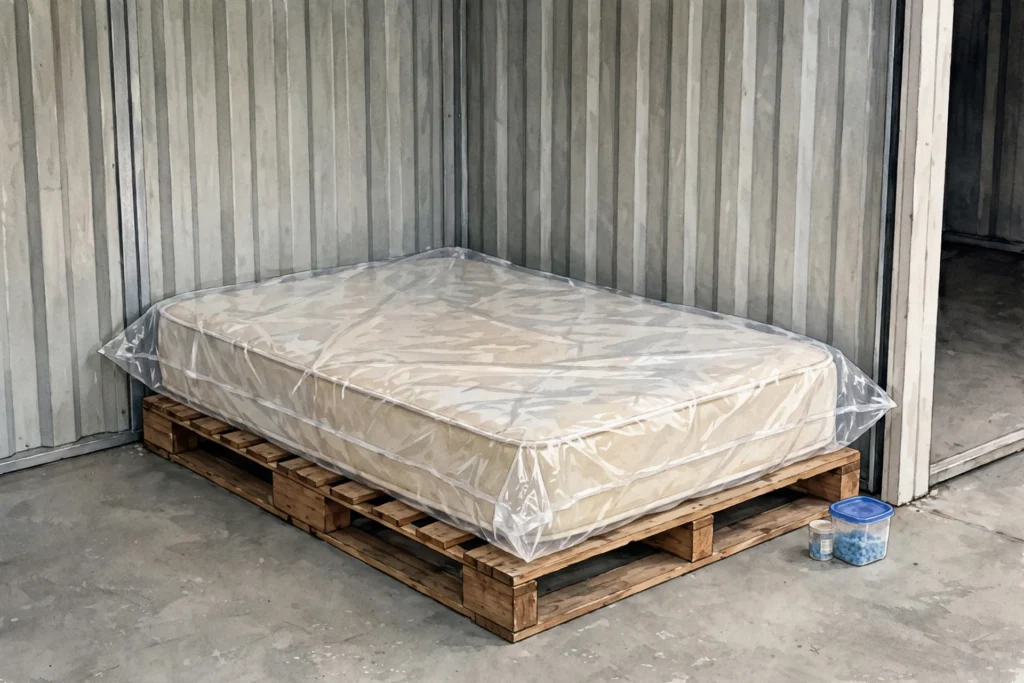
Lay it flat on a pallet or a sheet of plywood, off the concrete. Concrete can pass moisture from below even when the unit feels dry.
Keep the top clear for a long stay. Light bedding belongs beside the mattress, not on it. Boxes and furniture belong on the floor, not on the mattress. Boxes stacked on a mattress can leave dents, and a heavy item can break springs.
Leave a small gap between the mattress and the unit walls. Walls can be cooler and damper than the middle of the room, so a gap helps air move and keeps the mattress from pressing against metal. Leave a path to the mattress if you plan to take it out before the other items in the unit.
If you are storing a bed frame, take it apart. Wrap the headboard, footboard, and rails separately. Put the screws and bolts in a labeled bag. Store the frame pieces beside the mattress, never on top of it.
What about a mattress and box spring together?
Store them the same way, both flat, with the box spring underneath the mattress. Vacuum the box spring and let it dry, then bag it separately. Cover it with a second bag or a moving blanket if you do not have a second bag. The box spring takes the same pallet and the same gap from the walls. Together they stack to about a foot and a half high. The footprint is the mattress footprint, so floor space beyond that footprint remains for boxes, depending on the rest of the load.
What to Know About Storing a Mattress in a Standard Unit
Brushy Creek Storage offers standard storage units, not climate-controlled storage. Temperature and humidity inside a standard unit can change with outdoor weather, so a standard unit cannot provide the steadier conditions recommended for long-term mattress preservation.
If you store a mattress here, put it away clean and fully dry. Use a suitable mattress bag, lay it flat on a raised pallet or plywood, leave a gap between the mattress and the walls, and keep heavy items off it. During humid weather, a moisture absorber may help manage moisture nearby, but it does not control the unit’s humidity.
A garage, attic, or shed is not a substitute for a dry unit for a long stay. A garage stay should be short only, and only if the space stays dry.
Check the mattress about once a month during a long stay. Open the bag briefly and look for damp spots, a musty smell, pest signs, or changes in shape. If the mattress is damp, do not reseal it. Let it dry fully first, then bag it again. If the mattress is already damp, or you cannot check it during a prolonged spell of hot, humid weather, a standard unit may not be suitable for that storage period.
How long can a mattress stay in storage?
Months to a couple of years, if it went in dry and flat, bagged, raised, and checked. Time alone is not the main damage source. Damp and heavy weight on top do the real damage, but a mattress still ages during storage. A mattress that went in dry, flat, and clear on top may still be usable after a year, but inspect it before use. A mattress that went in damp, or spent a year under heavy boxes, is more likely to come out with damage you can feel.
Check your manufacturer terms before a long stay. Some makers define flat storage for extended storage, floor storage, and rolled-box deadlines as conditions for coverage. Keep the law tag on the mattress. Avoid water and stain damage. This guide cannot promise what a maker will cover.
When you take it out of storage
Remove the bag and air the mattress for a few hours. Inspect it for visible mold and new sagging, then vacuum it before use. Let memory foam warm to room temperature before you judge how it feels. If you find visible mold or a new deep sag, do not simply put fresh sheets back on it. Seek advice on whether it can be cleaned or needs replacement.
Questions people ask
Can I store a mattress on its side?
For a short time, yes. For months, no. Flat is the position that keeps its shape.
Should I wrap a mattress in plastic?
Yes, in a mattress bag made for the job. For a long stay, a breathable bag is better than thick sealed plastic, because thick plastic can trap moisture if the mattress is not fully dry. Make sure the mattress is fully dry before it goes in the bag, and tape the end shut on the bag, never on the fabric.
Will a queen mattress fit in a 10×10 unit?
Yes. It fits along one wall, leaving floor space for boxes and a disassembled frame, depending on the rest of the load.
How do I keep a stored mattress from smelling musty?
Dry it before bagging, and use baking soda for odors before it goes in. Keep it off the concrete on a pallet, and check it about once a month during a long stay, opening the bag briefly. A moisture absorber tub in the unit helps during the humid months, but it does not control the unit’s humidity.
The short version
Dry it before bagging. Lay it flat on a pallet. Keep the top clear. Look in on it about once a month during a long stay. That is the whole method, and it is what keeps a mattress usable through a move or a renovation.
If the mattress is part of a bigger move, the same packing logic applies to the rest of the load. Our guide on how to pack a storage unit covers the small-box method for everything else, and books ride along with their own packing rules if the home library is moving too. For the electronics in the load, our guide on how to store electronics covers batteries, packing, and setup.
If you are planning a move around Calera, Durant, or Colbert and the mattress is part of the load, call us at (580) 434-8269. Tenant access runs 6 AM to 9 PM every day.


