

How to Store Books in a Storage Unit
Yes, you can store books in a storage unit, and they can stay there for years in good condition. Two things decide how they come back out: the weight they are packed under, and the moisture in the air around them. Pack them dry, keep the boxes small enough to lift, get the boxes off the floor, and check on them now and then. Skip those steps and books come back with foxed pages, swollen covers, and spines that crack the first time you open them. This is the method we walk Calera and Durant customers through when they are storing a home library, a set of textbooks, or boxes of family records.
Why books get damaged in storage
Paper is absorbent, and the glue in a binding is not far behind. A book stored in a damp box slowly pulls humidity out of the air, and that moisture feeds mildew. Preservation guidelines put the safe zone for books at roughly 60 to 70 degrees with relative humidity between 30 and 50 percent, and mold risk climbs sharply when humidity sits above roughly 65 percent for days at a time, faster the damper conditions get. Oklahoma summers run humid, and a standard storage unit follows the weather outside, so a book that goes in damp will not dry out inside the unit. It will get worse, and it can spread mildew to the dry books sharing its box.
Weight is the second problem. Books are denser than almost anything else people store. A large box packed full of hardcovers can pass fifty pounds, and the boxes at the bottom of a stack carry the weight of every box above them. Bottom boxes crush, and the books inside them crush too.
Insects come third. Silverfish eat paper and the starch glue in bindings, booklice graze on mold in damp books, and moths go after bindings and covers. All three like the same conditions: dark, warm, humid, and undisturbed. They usually arrive inside boxes that sat in a garage or attic before the move, which is why the prep work happens before anything gets sealed. Sunlight rounds out the list. Covers fade and pages yellow in direct sun, which is one quiet advantage of a closed box inside a closed unit: stored books sit in the dark.
Before you pack a single book
Go through the shelves first. Storage charges by the unit, and there is no reason to pay to store books you would not open again. Donate the duplicates and the outdated manuals. What stays gets a quick inspection.
Check each book for dampness and mildew. A book that smells musty or shows spots on the page edges needs to dry out in the open air at home first, away from the healthy books. Wipe dust off the covers with a dry cloth, because dust holds moisture against the paper.
Take everything out of the books before they go into boxes. Bookmarks, loose notes, pressed leaves, paper clips, and staples all cause trouble in storage. Clips rust, inserts press dents into pages, and a forgotten bookmark can leave a permanent stain line across two pages. Slide each one out and set it aside. It takes seconds per book and it is the kind of detail collectors swear by.
Books should go into their boxes completely dry and clean. That one condition decides most of what happens over the following year.
If some of the books are valuable, first editions, signed copies, family Bibles, old yearbooks, make a simple inventory list before you pack. Note the title and the box number. Photograph the shelf before you start. The list takes ten minutes and it is the document you will want if you ever need to prove what was in the unit.
How to pack books, step by step
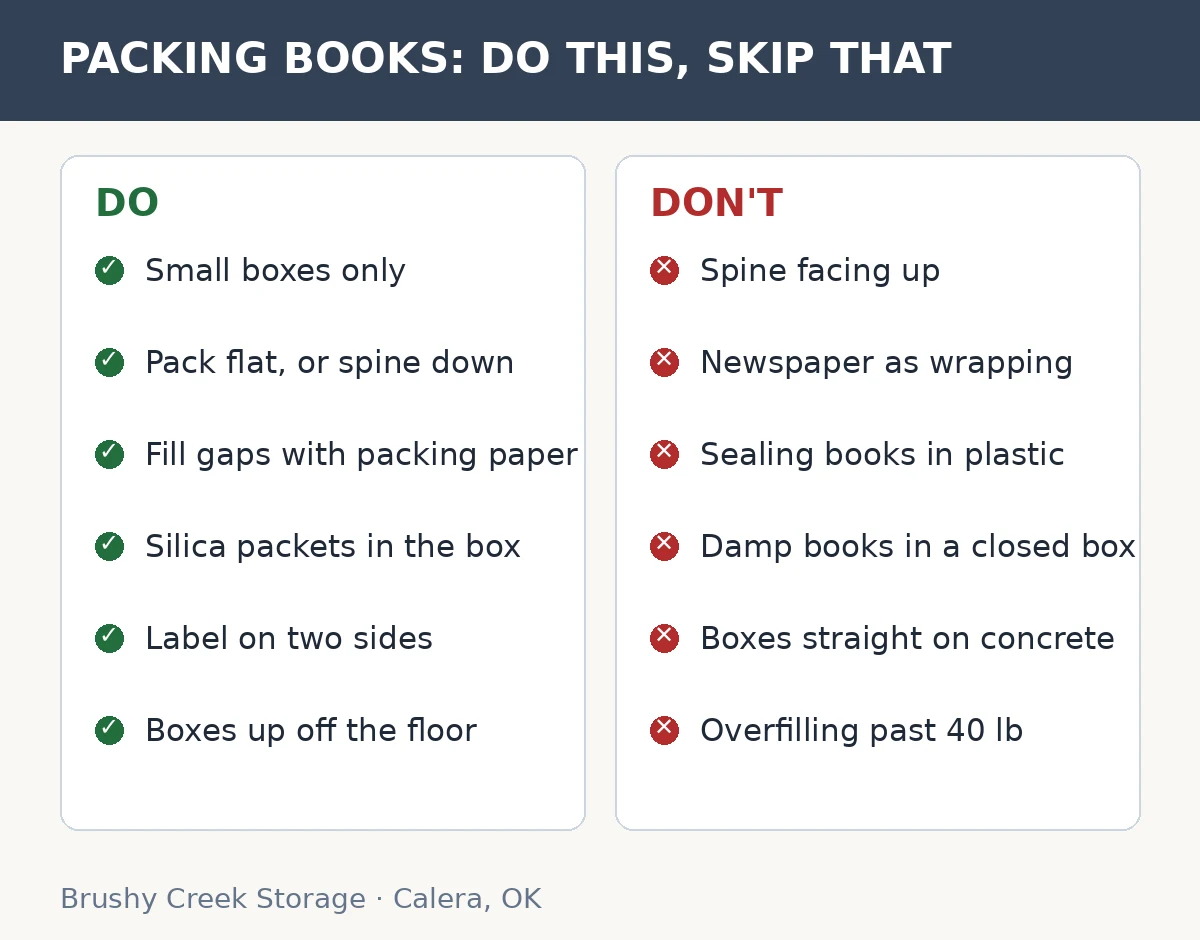
Use small boxes. A small moving box, roughly 1.5 cubic feet, is the largest box a book collection should go into, and even that will weigh around thirty to forty pounds when full. Publishers and movers put the ceiling for a box of books at forty to fifty pounds, and your back will argue for the lower end. If a box is too heavy to carry comfortably across a room, it is too heavy.

Pack hardcovers flat, stacked in short piles, or standing with the spine down against the bottom of the box. Paperbacks can stand upright the way they sit on a shelf. Never pack a book with the spine facing up and the pages hanging down from it. Gravity pulls the text block away from the binding in that position, and a few months of it can split the spine.
Pack to a count as well as a weight. A small box holds roughly twenty to twenty-five average books, fewer when they are large hardcovers. When the count and the weight disagree, trust the scale.
One thing never to pack books in: newspaper. Newsprint looks like free wrapping paper, but the ink transfers onto covers and page edges, and the paper itself is acidic enough to yellow what it touches. Use plain packing paper or acid-free tissue instead.
Our general guide on how to pack a storage unit covers the same small-box logic for the rest of a household load, and the two methods work together when books are only part of what you are storing.
Cardboard boxes or plastic bins?
This question comes up with every book move, and the honest answer depends on how long the books will sit.
Cardboard breathes. Air moves slowly through it, so a trace of humidity inside a cardboard box can escape instead of condensing on the books. For storage that runs past a season, cardboard is the safer container, and it is what most of the books in our units ride in.
Plastic bins protect better against water from outside, a roof drip or a wet floor, and they stack neatly. Their weakness is the lid. A bin sealed airtight with books that carried any damp in with them becomes a small greenhouse, and mildew is what grows in it. If you use bins, the books must go in bone dry, with a silica packet or two inside, and the stay should be shorter.
Whichever container you choose, one rule every mover and preservation guide repeats: do not wrap or seal the books themselves in plastic bags or film. Plastic against paper traps moisture exactly where the book can least afford it. If you want a plastic barrier, put it under the boxes, as a sheet over the pallet, where it blocks damp rising from the concrete without wrapping anything.
Fill the empty space in each box with packing paper so the books cannot shift. Label every box on two sides with its contents and a number that matches your inventory list. Future you, standing in the unit looking for one specific textbook, will be glad the boxes are numbered instead of all marked “books.”
Setting up the unit for books
Keep book boxes off the concrete. Put down pallets, wooden planks, or a low shelving unit before the first box goes in. Concrete sweats with temperature changes, and a box sitting directly on it absorbs that moisture from below even when the unit itself feels dry. Six inches of air under the boxes solves it.
Leave a small gap between your stacks and the unit walls for the same reason. Walls are where condensation forms first. A stack pulled two or three inches into the room stays noticeably drier than one pressed against the metal.
Stack heaviest boxes at the bottom and stop at a height you can lift from safely. Four or five small boxes is a sensible ceiling for a book stack. Anything taller tends to lean, and a leaning stack of books eventually becomes a fallen stack of books.
Silica gel packs or a moisture absorber tub inside the unit helps during the humid months, and they are cheap. Replace them when you visit. Plan on looking in on a stored collection every month or two, more often in the middle of summer. You are checking for the first signs of mildew and swapping the moisture absorbers while there is still nothing to fix. Visits are easy to make, since tenant access at Brushy Creek runs 6 AM to 9 PM every day.
Should books go in a climate-controlled unit?
For a rare collection or books that will sit for several years in a humid climate, a climate-controlled unit is the lower-risk home, because it holds temperature and humidity near that 60 to 70 degree, 30 to 50 percent range on its own. That is the straight answer, and any facility that rents climate units will give you the same one.
Brushy Creek rents standard drive-up units. The steps in this guide, dry packing, pallets, wall gaps, desiccants, regular checks, reduce the avoidable risks, and for a typical home library stored around a move they are sensible precautions. They do not turn a standard unit into a controlled preservation environment, and we will not pretend otherwise. Households storing with us are usually keeping books for a season or a few years, and precautions match that job. If your collection is rare, irreplaceable, or the kind a collector insures piece by piece, it belongs in a controlled environment, and we would rather tell you that plainly than rent you space that is wrong for it.
Can you store books in a garage instead?
People ask this because the garage is free. A garage is also a rough room for paper. Its temperature swings wider than a storage unit’s, mice treat it as a hallway, and anything on its floor is one heavy rain or one plumbing leak away from a soaking. Attics run hotter still, and basements trade the heat for damp.
Books do survive garages for a while, and plenty of people keep them there between moves. If the collection matters to you, though, a unit gives it a dedicated enclosed space, one door, one lock, your own access code on the gate, and nobody parking a car next to it. For most households that difference is the whole argument.
How long can books stay in a storage unit?
Years, if they went in right. Libraries and book dealers store stock for far longer than a household rental usually runs. The limiting factor is almost never time by itself. It is the conditions the books spend that time in, which is why the checks matter. A two-minute look every month or two catches a mildew spot while it is still one book instead of one box. Books packed dry, kept off the floor, and checked on that rhythm come out of a three-year rental in the same shape they went in.
How much storage space do books take?
Books take less room than people expect, right up until they take more. A single standard bookshelf holds roughly 100 to 150 books across its shelves. At twenty to twenty-five books per small box, that shelf packs into about five to seven boxes. A thousand books, a serious home library, fills forty to fifty small boxes depending on how many are oversized hardcovers.
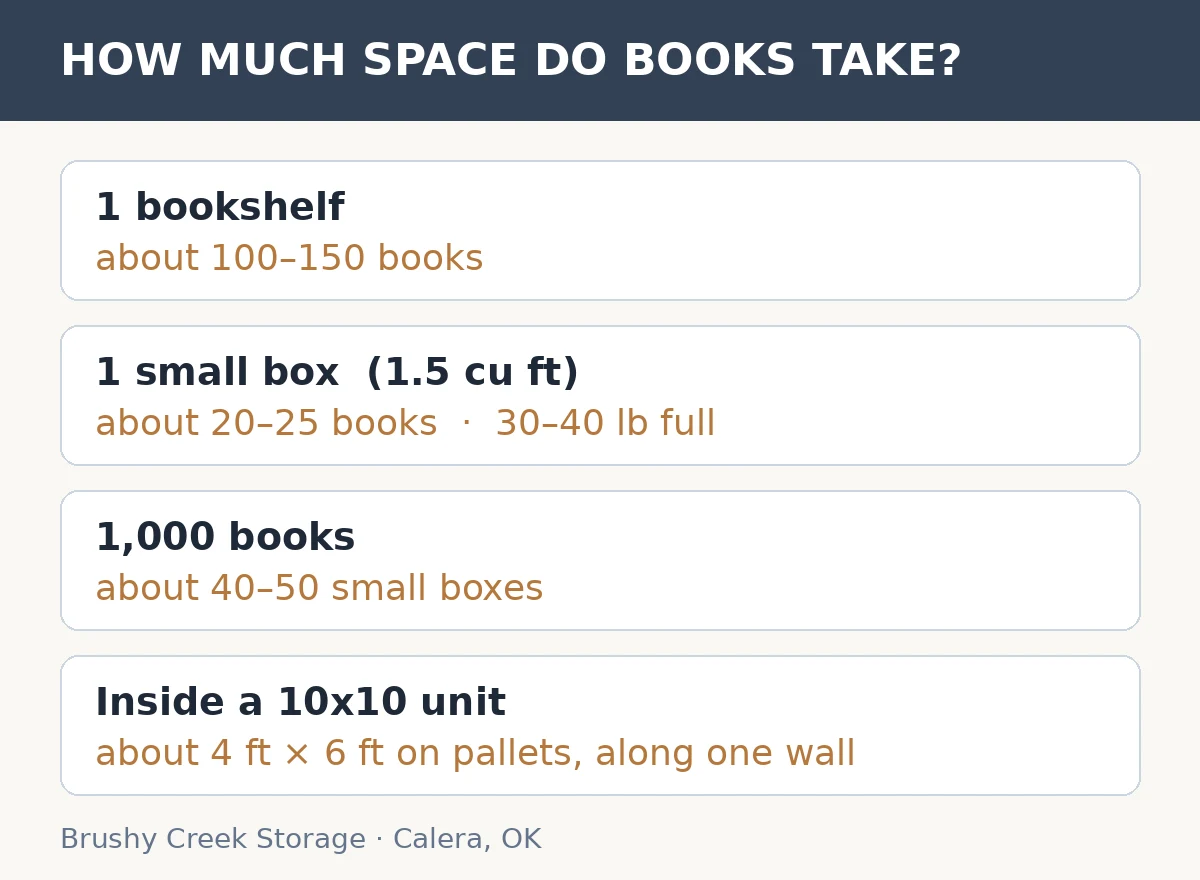
Stacked on pallets, fifty boxes occupy a footprint of about four feet by six feet. That fits along one wall of a 10×10 unit with most of the unit left over for furniture and everything else from the house. Books alone rarely justify a unit by themselves. They usually ride along with a move, a renovation, or an estate cleanout, and they take a corner of a unit that was rented for the whole job. Our storage unit sizes and prices page lays out what the 10×10 and the 10×20 hold and what each one costs, so you can size the unit for the whole load instead of guessing.
A note on textbooks and course books
Students at Southeastern Oklahoma State University run into a smaller version of the same problem every May. Textbooks are expensive, dorm rooms empty out for the summer, and the books have to live somewhere for three months. The same packing rules apply at that scale. Small boxes, books packed dry, boxes off the floor. A semester’s worth of textbooks is usually two or three boxes, and they stack in a corner of a unit shared with the rest of a dorm room. What matters most for textbooks is the inventory list. Course books look identical in a box, and the one you need in August is always at the bottom.
Storing books that are worth money
Sentimental books and valuable books are not always the same books, but both kinds deserve one extra step at packing time. Wrap valuable volumes individually in acid-free paper before they go into the box, and leave dust jackets on. The jacket is the book’s first layer of protection, and for collectible copies it carries part of the value. Acid-free boxes are worth their small premium for the volumes at the top of the collection. Ordinary packing paper is fine for the rest.
If a collection has real value, a first printing, a signed copy, records your family cannot replace, look at the tenant protection plan before the books go in. The plan covers the value of what you store, and books are exactly the kind of property people forget to account for until something goes wrong. Bring your inventory list when you rent. The list you made during packing doubles as the record of what the unit holds.
Store the most valuable boxes in the middle of the unit rather than against the door. They stay furthest from weather, from dust, and from the working end of the space where you will be moving other things in and out.
Questions people ask about storing books
Can you store books in a storage unit?
Yes. Books are one of the most common things in storage. They store well when they go in dry, sit off the floor in small boxes, and get checked every month or two.
Should books be stored flat or upright?
Both work. Hardcovers can lie flat in short stacks or stand with the spine down. Paperbacks stand upright like they do on a shelf. The one position to avoid is spine up, with the pages hanging from the binding.
Are plastic bins safe for books?
For shorter storage, yes, as long as the books go in completely dry and you add silica packets. For storage past a season, cardboard is safer because it breathes. Either way, never seal the books themselves inside plastic bags or wrap.
What temperature is best for storing books?
Preservation guidelines say roughly 60 to 70 degrees and 30 to 50 percent humidity. A standard unit will not hold those numbers on its own, which is why the packing and checking steps matter: they reduce the risks a standard unit cannot control by itself.
How often should you check stored books?
Every month or two, and more often in mid-summer. You are looking for early mildew and tired moisture absorbers, both cheap to fix when caught early.
The short version
Dry books, small boxes, a count of twenty-odd books per box, nothing wrapped in plastic, no newspaper anywhere near them, boxes up off the concrete, gaps at the walls, and a look inside every month or two. Those steps give a book collection its best protection inside a standard unit through an Oklahoma summer, and books treated that way usually come back out ready to go straight back on the shelf.
If you are planning a move or clearing out a house around Calera, Durant, or Colbert and the books are part of the load, call us at (580) 434-8269. Tell us roughly how many shelves you are packing and we will tell you honestly whether they fit the unit you already need or change the size you should rent.


